
Los Angeles, Paris and Berlin are wearing Yiddish. But not in the same way.
Yiddish words are back on the street.
On T-shirts, caps and sweatshirts. On jewellery, postcards and keychains. Sometimes even on jars of pickles.
At first glance, the idea may seem similar. Look a little closer, however, and three very different stories begin to emerge.
In Los Angeles, Paris and Berlin, three independent labels are working with Yiddish language, Jewish culture and contemporary clothing.
They may share a few words.
Perhaps even a few customers.
But they do not share the same perspective.
Los Angeles: a family story
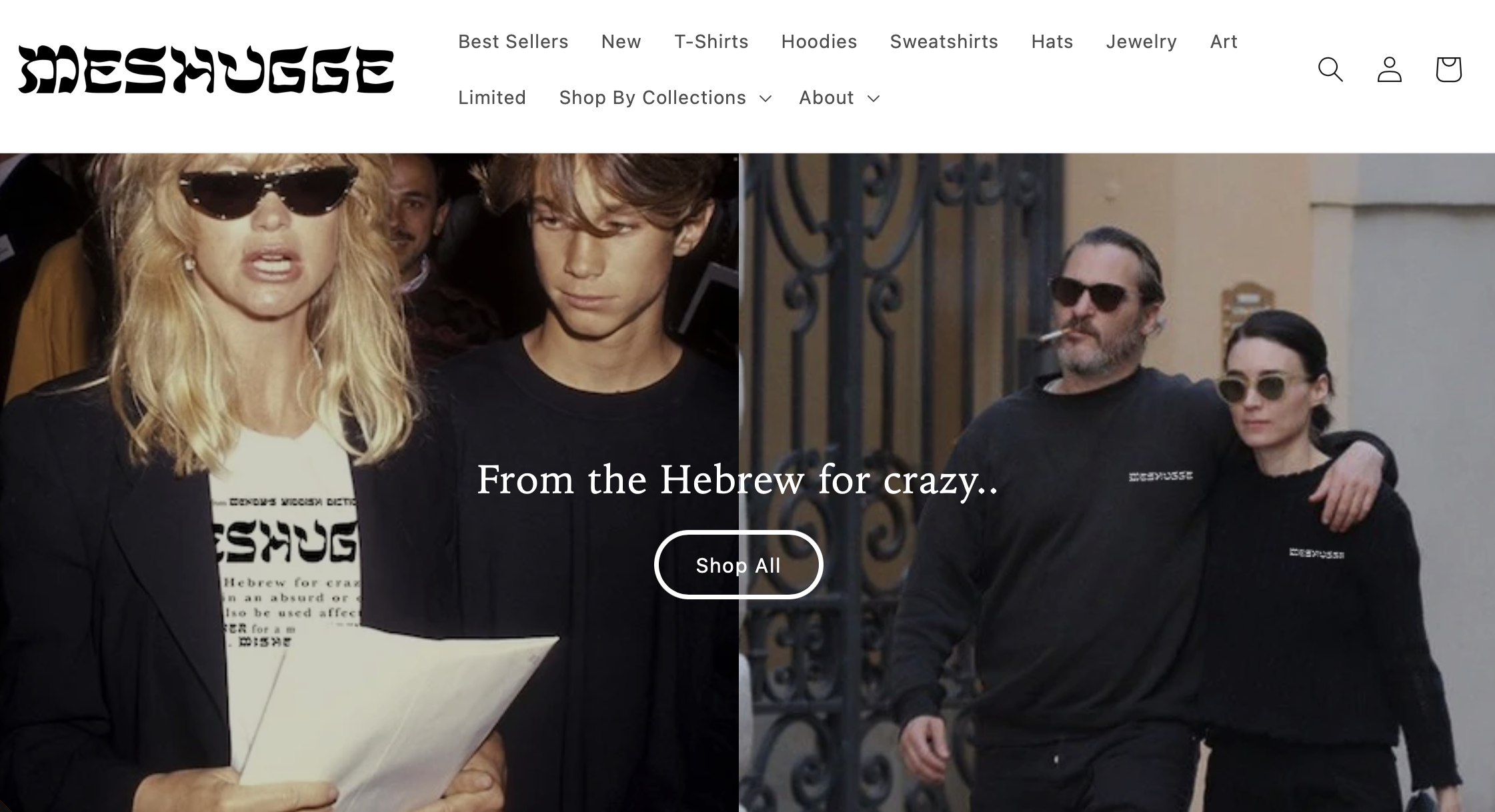
Meshugge was created in honour of the founder’s grandfather, Mendy: a native New Yorker whose independence, creativity, eccentricity and sense of humour continue to shape the brand.
The label is designed in Los Angeles, but its emotional home is unmistakably New York.
Meshugge describes itself as a Jewish clothing brand existing at the intersection of Yiddish culture and premium casualwear. At the same time, it presents itself as an open invitation to anyone who wants to become part of the story.
Its collections carry names such as MENSCH, SCHMUCK, MESHUGGE and OY VEY CLUB.
Many of the designs work almost like wearable dictionary entries: a Yiddish term, its meaning and different linguistic variations. Clothing is accompanied by jewellery, artwork and Judaica.
The communication feels warm, personal and accessible.
It begins with one family story and expands into a broader invitation:
Let’s keep something alive together.
And because this is an American brand, that invitation is communicated quite directly through drops, collections and offers.
Heritage meets retail.
Paris: a living culture
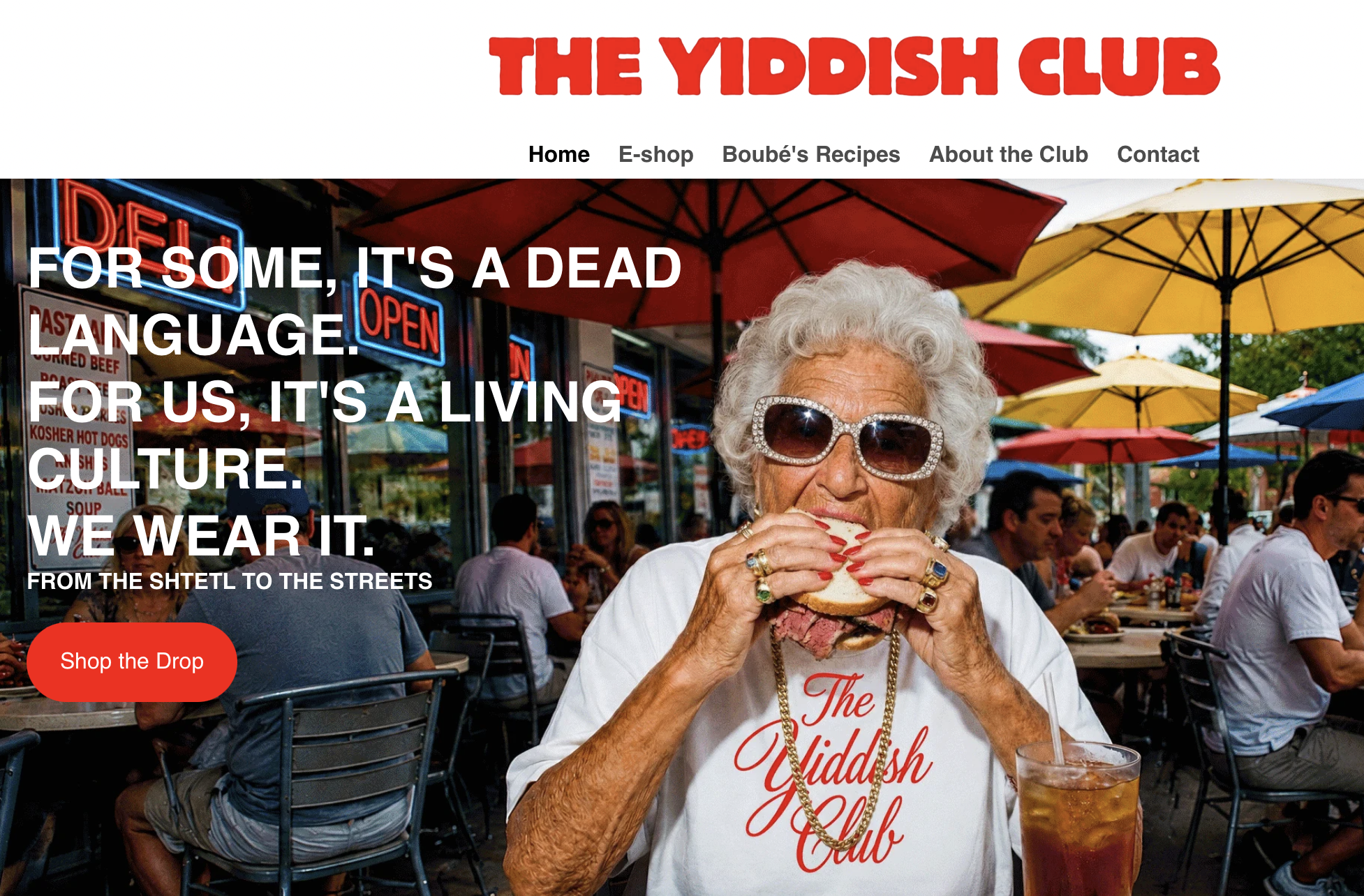
The Yiddish Club begins somewhere else.
“For some, it’s a dead language. For us, it’s a living culture.”
This sentence is more than a slogan.
It is the entire concept.
For The Yiddish Club, Yiddish does not live in words alone. It lives in the smell of strudel, the taste of kreplach, an accent, a joke, a memory, an object and a certain sense of style.
The brand wants to make that heritage visible, alive and desirable.
Accordingly, The Yiddish Club does not simply sell clothes.
It creates a world.
That world includes Boubé’s recipes, playlists moving between old delis, dirty rap, smoky jazz and Miami in 1987. It includes pickles, postcards and collaborations with places connected to Jewish life and culture in Paris.
For a collaboration with Florence Kahn, an institution in the Marais, even a sandwich was treated as a piece of cultural heritage.
The accompanying shirt tells a story about pastrami, the Pletzl, family recipes and a historic shop in the Rue des Écouffes.
The communication is poetic, sensual and carefully curated.
A little shtetl.
A little Lower East Side.
A great deal of Paris.
You are not simply buying a T-shirt.
You are joining a club.
Berlin: the word is the design
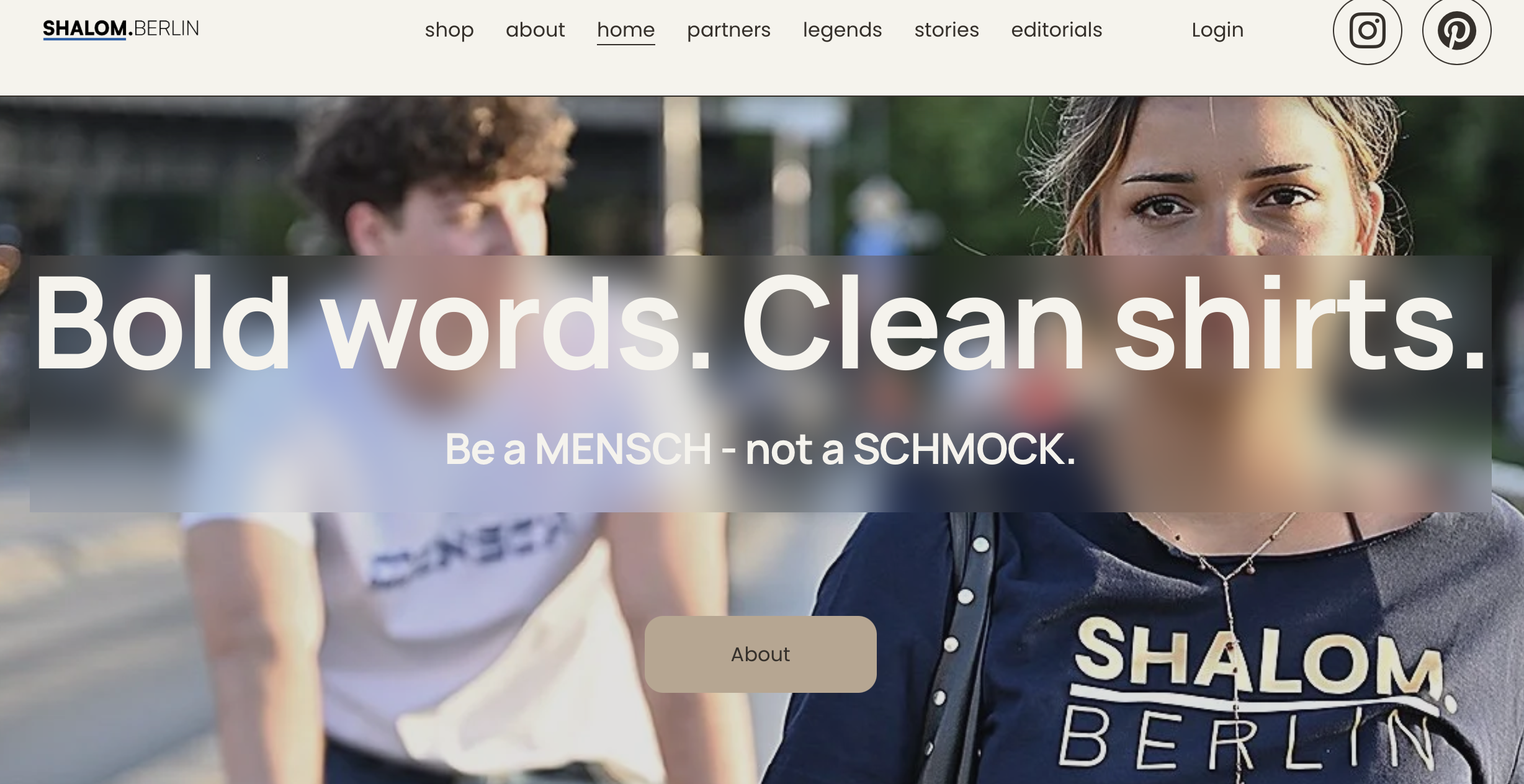
SHALOM.BERLIN takes a different approach again.
We are not dealing with Yiddish as a closed or historical language. Nor are we creating Jewish fashion in the traditional sense.
We are dealing with words.
Words of Yiddish origin that have long since become part of everyday German.
Words such as MENSCH, SCHLAMASSEL, CHUZPE, PLEITE or MALOCHER.
They are used every day, often by people who no longer know where they came from.
SHALOM.BERLIN does not take these words out of a museum.
We put them back on the street.
Reduced to one expression and one short comment:
be a MENSCH
don’t be a SCHMOCK
MALOCHER — stay dirty
PLEITE — berlin standard
No dictionary definitions.
No folklore.
No nostalgic reconstruction.
Just language, irony and Berlin.
The visual language follows the same principle: clear typography, a limited colour palette, short sentences and real locations across the city.
Where Meshugge continues a family story and The Yiddish Club creates an entire cultural world, SHALOM.BERLIN points towards something that is already here: the Yiddish sound within the German language.
You only have to listen closely.
Same roots? Different stories.
Perhaps the three perspectives can be summed up like this:
Los Angeles wears memory.
Paris turns culture into a world.
Berlin puts words back on the street.
Meshugge seems to say: Let’s preserve this heritage.
The Yiddish Club says: Let’s live inside it.
SHALOM.BERLIN says: It is already part of our everyday lives.
None of these perspectives is more correct than the others.
They simply begin in different places:
with a person,
with a culture,
and with a language.
Perhaps that is exactly what makes them interesting.
Yiddish does not appear here as one uniform retro trend.
It is developing new forms, new images and new accents.
In Los Angeles.
In Paris.
In Berlin.
Same roots?
Maybe.
Same style?
Not at all.
Good.